
Anne Wieler
Anne Weiler is a student in History and IR, recently graduated with a BA. She wrote this blog as part of the ‘Historicizing Security’ course at Utrecht University.
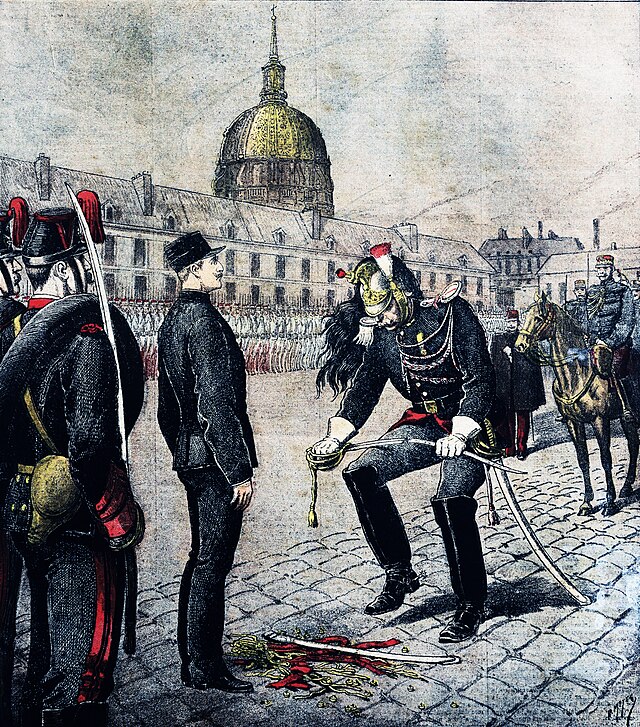
On January 5th 1895, Paris echoed with somber military drums. From beneath their heavy beat rose a surge of furious voices : “Death to the traitor!” “Dirty Jew!”At nine o’clock, in freezing weather, Alfred Dreyfus stepped on the Place Fontenoy to face public humiliation and military degradation. The trial’s sentence was read out loud, the insignas stripped off the capitain’s uniform and ‘crack!’ the sword of the innocent man was broken in half.
The Dreyfus Affair was a justice scandal in which Alfred Dreyfus, a Jewish Alsatian officer, was wrongfully arrested for passing military secrets to Germany. It was one of modern France’s most divisive political crises. It had considerable ramifications on the nation, influencing political and religious development in the country. This blog will analyze how the French Army, aided by antisemitic nationalists, enabled extreme measures against Alfred Dreyfus by framing him as an existential threat. Through an examination of media representations and symbolic particularities, it will explore how such trials acquire powerful symbolic significance when their religious, social, and political tensions are exploited.
Fear and Prejudice in the 1890s
The Dreyfus Affair unfolded as France grappled with the trauma of its defeat in the Franco-Prussian War. This defeat triggered a widespread desire for security and stability which fostered the idolization of the army and a nationwide spy mania. Two trends dominated France’s political culture at this volatile moment, one humanist/universalist, embodied by the Third Republic ; the other a nationalist one which drew on antisemitism and fostered the spread of beliefs in genetic-determinism.Moreover, multiple economic failures experienced in the last years were blamed on Jewish financiers. The Catholic Church had also already launched an anti-Jewish campaign warning against the “stranglehold” of Jews on French society.
The Dreyfus case
It was within this tense antisemite context that the Dreyfus Affair took place. On September 25th 1894, Major Henry, head of counter-espionage in the French army, received a torn document from the German Embassy’s wastebasket containing French military secrets. The presence of a spy in the Army became an urgent matter. Major Henry and his superiors immediately singled out Alfred Dreyfus : ‘While he is intelligent and very gifted, he is pretentious and does not fulfil (…) his conscientiousness and the execution of his duties’ (Cahm, 1996). The officer was unpopular among his peers for his wealth and cold personality, but his biggest ‘wrongdoing’ seemed to be his Jewish background. Under pressure to prevent further scandal after early missteps in office, General Mercier, Minister of War, endorsed Dreyfus’ guilt. This led to his arrest on October 13, 1894.
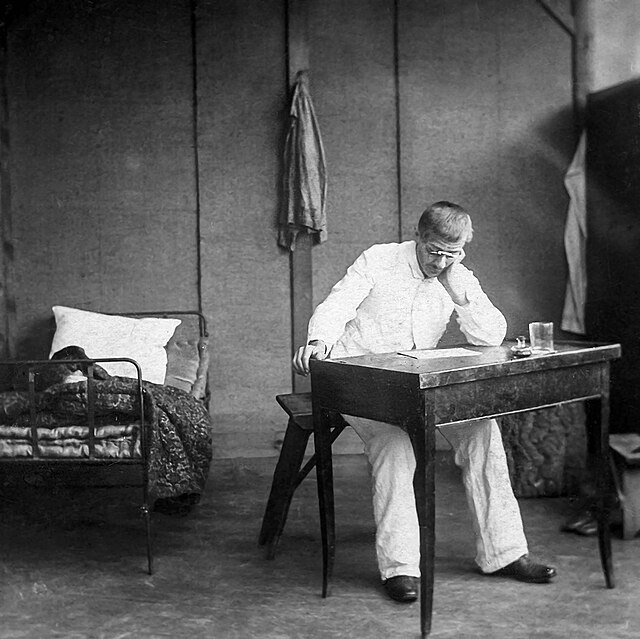
After a manipulated and biased trial held exceptionally in camera (without any press or public present), Dreyfus was found guilty. He was sentenced to military degradation and imprisonment for life. The law was altered to send the convicted to the Devil’s Island, an old leper colony in French Guiana, where his family could not visit him. The climate there was harsh and malarial, the prisoner was placed in double irons and attached by the legs at night so he could not move. Alfred Dreyfus wrote :
‘The torture was horrible […]. Putting in irons, a security measure!’, ‘It is a measure of hatred and torture, ordered from Paris by those who, being unable to strike at a family, are striking at an innocent man.’ (Cahm, 1996)
This illustrates how the army employed extreme measures against Dreyfus under the guise of security. Through legal manipulation, courtroom falsehoods, and the exploitation of antisemitism, the French army sought to securitize the affair. These efforts nevertheless depended on public acceptance. Two campaigns arose, reflecting the deep split in French society: the anti-Dreyfusard and the Dreyfusard.
The Dreyfus Affair
The Dreyfus Affair attracted widespread attention because it gave discontented groups a chance to oppose the Republic. Antisemitic nationalists exploited this unrest. They blamed Jews for all societal problems, such as corruption and rural hardship. As Jean-Paul Sartre observed much later on, “If the Jew did not exist, the anti-Semite would invent him.” (Burn, 1984). Works like Drumont’s La France Juive spread all across the country. They portrayed Jews as conspirators, exaggerated their numbers, and blamed them for usury, even though most rural moneylenders were local Christians. This scapegoating drew on medieval myths and conspiracy narratives that helped legitimize exclusionary measures and securitization.
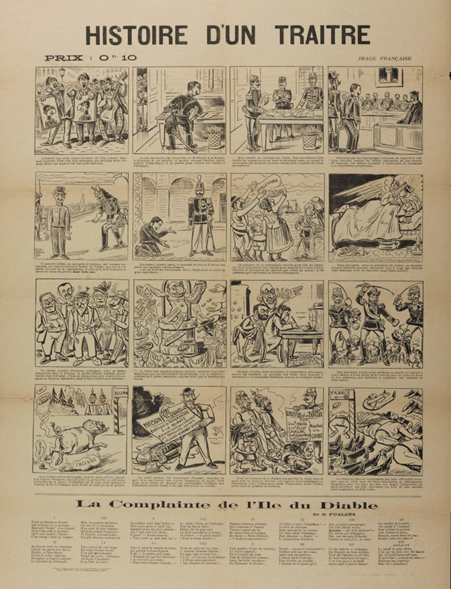
The propaganda poster ‘Histoire d’un Traitre’ is one of the most popular works of the anti-Dreyfusard campaign. On this one-page comic strip the first phrases mention the former officer’s religion before even mentioning his name: ‘He was Jewish and as a Jew it is impossible for him to understand everything that the sacred word ‘Patrie’ represents for us French people.’ Dreyfus is caricatured and associated with the Freemasons, further extending the web of conspiracy narratives. The affair was not simply about Dreyfus anymore; it was about the Jew.
The Dreyfusard campaign began with Dreyfus’ brother, Mathieu. He spread a rumor about Alfred’s escape to draw public attention. This campaign similarly used newspapers, myths and intellectual figures. It turned the affair into a symbol of injustice rather than perpetuating the idea of a security issue.The movement gained momentum in 1899 when Lucie Dreyfus secured a retrial, rallying Dreyfusards as well as skeptics of the army and government.
On 12 July 1906, the innocent Alfred was officially exonerated, reinstated in the army, and awarded the Legion of Honour. Ultimately, the anti-Dreyfusards failed to securitize the affair nationally or over the long term. Weak rural coordination within the movement, combined with growing distrust of the government and military, allowed Mathieu Dreyfus’s counter-campaign to offer a compelling alternative narrative and clear his brother’s name.
Conclusion
Overall, the French Army and the antisemitic nationalists had a mutual influence on each other in this case. The Army justified its actions against Dreyfus as vital to security, while antisemites exploited the alleged threat to advance their own political agendas. Although the securitization process failed, it still deeply divided French society. It also influenced the polarized 1898 elections and led to a Dreyfusard-led coalition victory in 1902, culminating in the 1905 Separation of Church and State.
Finally, this political scandal had a global impact. It was widely covered in media and followed across continents. Some see this case as the beginning of Theodore Herzl’s theory of zionism. Indeed, he reported on the Affair : ‘If France, the home of the Revolution, was susceptible to the basest anti-semitism, was that not proof of the need for a Jewish homeland?’(Begley, 2009). More than a century on, the Dreyfus Affair still resonates. For instance, last summer President Macron designated the 12th July as the annual day of commemoration for the case (Libération, 12 July 2025). Remembering the story of this innocent man standing under the snow on the 5th of January 1895, serves as a stark reminder of how the language of security can be weaponized during troubled times.
COVER IMAGE: The traitor: Degradation of Alfred Dreyfus, degradation in the Morland Court of the military school in Paris. Source: Wikimedia Commons.
Opinion pieces have been published by the Security History Network for the purpose of encouraging informed discussions and debates on topics surrounding security history. The views expressed by authors do not necessarily represent the views of the SHN, its partners, convenors or members.
 The Security History Network