
Fons Borm
Fons Borm is a PhD candidate at Utrecht University. This blog is based on his dissertation, De adoptie van de telegrafie in Nederland en Nederlands-Indië, 1845-1914: politieke sturing en economische betekenis (Hilversum 2026).
The introduction of telegraphy in the 19th century impressed the Dutch government of the link between technological sovereignty and security. The current heated debate over digital sovereignty is nothing new. In this blog, Fons Borm explores the relationship between security and technological sovereignty for the Dutch government in the nineteenth century, with a focus on telegraphy. During this period, telegraphy developed into a revolutionary communication technology. It created new virtual public spaces that facilitated market integration and transformed business practices. Telegraphy also became both a ‘tool of politics’ and a ‘tool of empire’. After 1871, however, geopolitical developments began to impose limits on technological sovereignty. In this respect, the First World War proved to be a harsh lesson. The Dutch case shows that technological sovereignty depended not only on national ambition, but also on fragile international power relations.
Telegraphy is a state affair
With the Telegraph Act of 1852, telegraphy in the Netherlands became a political instrument for the construction of the liberal national unitary state. A state service, the Rijkstelegraaf, was established and tasked with building a national network of telegraph offices and creating connections with neighbouring European countries. Accessibility and affordability for every citizen formed the central political objective.
In the Dutch East Indies, by contrast, telegraphy was deployed to strengthen colonial rule. The Gouvernementstelegraaf was established as a state agency in 1855, with the task of opening telegraph offices in the principal cities on Java and developing a connection with the metropole. An initial step in this process was the laying of a submarine cable between Batavia and Singapore. Accessibility and affordability were aimed at the small group of European residents on Java, rather than the local population. Telegraphy thus functioned as an instrument of colonial domination.
Neutrality and sovereignty in the context of dependence
The Europeanization and globalization of telegraphy confronted the Dutch government with new security challenges. The Netherlands’ international security policy was, in diplomatic terms, largely guided by two principles: the preservation of neutrality and the exploitation of opportunities to strengthen sovereignty.
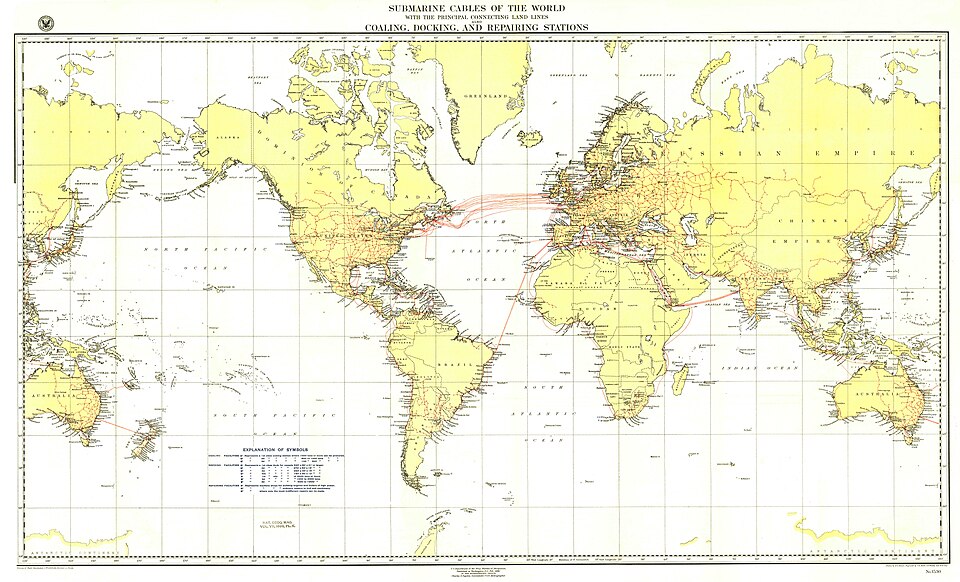
The safeguarding of neutrality in the field of telegraphy took shape through a preference for multilateral cooperation, such as within the International Telegraph Union. By contrast, owning submarine cables was seen as a means to strengthen technological and political sovereignty. This, however, proved difficult to achieve. The construction of proprietary cable connections by the Gouvernementstelegraaf in the period 1858–1870 was unsuccessful, leaving the connection between the Netherlands and Java dependent on the British cable company the ‘Eastern’.
This dependence was initially accepted, as long as free and equal access to the network was guaranteed. After 1871, however, this principle came under increasing pressure due to shifting geopolitical relations. On 14 October 1899, Dutch confidence was seriously undermined when the British government, in the context of the Second Boer War, imposed military censorship on telegraph traffic between Aden and South Africa. This compromised the security of ‘het wereldtelegraafnet’ and turned technological sovereignty into a national necessity.
Change in international relations
The shock caused by the breach of trust in the independence of British submarine cables within the context of international power politics prompted businessmen from Amsterdam and Rotterdam with interests in the Dutch East Indies to establish the ‘Comité inzake de bevordering der telegraphische gemeenschap’. The aim of this committee was to create an independent ‘telegraphic community’ by laying trans-Indies submarine cables to the Dutch East Indies, thereby breaking the British monopoly.
The project was conceived as a private investment initiative, for which government support was deemed essential. As the Netherlands could not carry out the project independently, cooperation was sought with other colonial powers in Asia, particularly the German Empire and France. In the course of 1900, the first discussions took place, on the one hand between the committee and the Ministry of Colonies, and on the other with representatives of the German Imperial Post Office and the German cable industry.
The intra-Asian network was envisioned around a central hub on the German island of Yap. From this hub, several connections were to be established: an American link to the trans-Pacific submarine cable, a Dutch connection to Menado on Celebes, and German links to the colonies of Kaiser-Wilhelms-Land and the Caroline Islands. In addition, a German connection was to be constructed to Shanghai in China, where a German post office was located, with a further extension to Kiautschou.
In Shanghai, a connection would also be established with the Danish cable company Great Northern Telegraph Company. Through this German-Dutch intra-Asian network, both German telegraph offices and those of the Gouvernementstelegraaf would be able to route traffic to Europe via multiple channels: the American-German Pacific connection, the Danish-Russian ‘Northern’, or the British ‘Eastern’. In this way, the existing monopoly would effectively be broken.
The Dutch government, represented by the liberal Minister of Colonies J. Th. Cremer, expressed enthusiasm for plans to establish an independent submarine cable network in Asia. The proposal aligned with the broader aim of strengthening national sovereignty through joint ownership of submarine cables.
Managing political risks
However, cooperation with the German Empire in the field of telegraphy also entailed risks for Dutch neutrality. For this reason, parallel negotiations were conducted with France regarding possible intra-Asian submarine cable connections.
The Dutch government provided political and diplomatic support for the project and, on 24 July 1901, concluded a treaty with the German Empire for the construction of a German-Dutch telegraph network. The Netherlands guaranteed an annual subsidy and granted a concession to a newly established German-Dutch company: the Deutsch-Niederländische Telegrafen-Gesellschaft (DNTG).
The DNTG’s objective of achieving independence from British cable companies was not realized. It was forced to join the existing cartel on the intra-Asian cable market, led by the British ‘Eastern’. The DNTG had no choice but to enter into a cartel comprising the British ‘Eastern’, the Danish ‘Northern’, and the American ‘Commercial’, with the ‘Eastern’ in a dominant position. These arrangements remained secret, allowing the Minister of Colonies to maintain politically that the DNTG had broken the British monopoly in the Far East.
In practice, however, the DNTG posed a risk to the free accessibility of the Dutch East Indies. With the outbreak of the First World War, this risk became reality. On 7 October 1914, the DNTG’s services came to a complete halt when Japanese troops landed on Yap to disable the German segment of the network.
History as a political lab for debate on digital sovereignty strategy
These events demonstrate how international power relations undermined the Dutch pursuit of technological sovereignty. This experience provided an important impetus for developing an alternative in the form of a wireless connection with Java, which was ultimately realized in 1923.
Debates about dependency on foreign digital infrastructure, submarine cables and communication platforms are therefore not uniquely twenty-first century concerns. The Dutch experience with telegraphy shows that technological sovereignty has long been inseparable from international tensions.
COVER IMAGE: Connecting the world: submarine cables of the world, 1896 (Source: Wikimedia Commons)
Opinion pieces have been published by the Security History Network for the purpose of encouraging informed discussions and debates on topics surrounding security history. The views expressed by authors do not necessarily represent the views of the SHN, its partners, convenors or members.

